The Quiet Current: Turning Transformation into Reality
A river doesn’t carve a canyon in a day. It doesn’t crash through with one dramatic flood. It works quietly—grain by grain, drop by drop—until even the hardest rock gives way.
But in business? We often chase the flood. We launch big-bang initiatives, roll out bold strategies, and issue top-down mandates, hoping momentum will do the trick. And yet, when the excitement fades and the waters settle, the landscape often looks… exactly the same.
“But why do these well-designed strategies fail? The answer lies in what we often overlook…“
Where We Go Wrong
Here’s the trap: we assume success is all about quality.
So we design flawless systems, elegant workflows, and airtight strategies. But we forget a crucial second ingredient: acceptability.
Even the smartest solution goes nowhere if no one embraces it.
It’s like building beautiful ghost cities in China — with no takers.
Here’s the simple equation:
Q × A = E
Quality of change × Acceptability of change = Effectiveness of change
The Missing Multiplier
Quality is easy to measure. It fits neatly into KPIs, project plans, and boardroom slides.
Acceptability? That’s messier. It lives in the human space—habits, emotions, resistance, and trust. And that’s where most transformations stumble.
Here’s the deeper truth: most change doesn’t feel like gain—it feels like loss.
Even when the change is meant to improve things, people often experience it as:
- Something taken away (a familiar tool, a routine, a sense of control)
- Something added (more steps, more complexity, more work)
- Something being risked (status, competence, comfort)
This triggers resistance. People don’t change just because something makes logical sense. We’re wired to stick with what we know. We fear loss more than we crave gain.
It’s like asking someone to give up their favorite coffee mug for a new one—even if the new one is objectively better, they’ll hesitate.
A Tale of Two Transitions: Cisco vs. Zoom
Years ago, I worked with a banking GCC that invested in a high-end video conferencing solution—Cisco’s Tandberg system. It was secure, scalable, and packed with enterprise-grade features. On paper, it was perfect.
In reality? Adoption was painfully slow.
Despite training sessions, internal campaigns, and executive mandates, it took nearly five years to see meaningful adoption. Why? Because the system was complex, unfamiliar, and out of sync with how people naturally worked. “Employees dreaded logging into Tandberg—it felt like setting up a spaceship. The humble phone was so much easier.
Then came COVID.
Almost overnight, the same workforce switched to Zoom. It wasn’t as secure. It lacked many enterprise bells and whistles. But it was simple, intuitive, and acceptable. People embraced it instantly—not because it was perfect, but because – Zoom Two clicks and you were in.
Guide the Current
So what’s the alternative? Instead of forcing a flood, leaders can nudge the current—small, smart interventions that make the right behaviour feel natural, easy, even rewarding.
You’ve seen nudges everywhere:
- Apps like Duolingo reward you for maintaining a streak.
- Food delivery apps like Zomato or Zepto send you discount nudges during peak hunger hours.
- Coffee shops fill the air with the smell of fresh brews to stir comfort and appetite.
- Supermarket placement put fresh produce at the entrance to set a healthy tone, candies at eye level of kids
These aren’t accidents. They’re subtle cues that influence behaviour without shouting. So why not use the same approach in transformation?
Nudges That Can Make Change Stick
1. Gamification: Make Change Visible
Change often feels invisible. And what we can’t see, we resist. Gamification brings progress to life:
- Dashboards showing adoption growth
- Digital badges for milestones
- Leader boards sparking friendly competition
Suddenly, what felt like a chore becomes a game people want to win.
2. Timely Prompts: Catch the Moment
Intentions fade. Prompts bridge the gap between “I meant to” and “I did”:
- A pop-up when someone reverts to the old way
- A gentle nudge to complete a task before logging off
These aren’t nagging reminders—they’re helpful guides, right when they’re needed.
3. Meaningful Rewards: Celebrate the Right Things
Rewards don’t have to be bonuses or gift cards. Often, what matters most is being seen:
- A shout-out from leadership
- Featuring “change champions” in newsletters
- Small perks like flexibility for consistent adopters
These signals say: “We see you. And it matters.”
The Real Equation of Transformation
Nudges don’t improve the quality of your change. They improve its acceptability—and that’s what makes it effective.
- A high-quality initiative with no buy-in? It stalls.
- A decent idea with strong support? It can fly.
When you layer nudges with leadership support, aligned incentives, and trust, you don’t just implement strategy—you bring it to life.
The Power of the Quiet Current
Canyons aren’t carved by floods. They’re shaped by quiet, persistent currents.
Transformation works the same way.
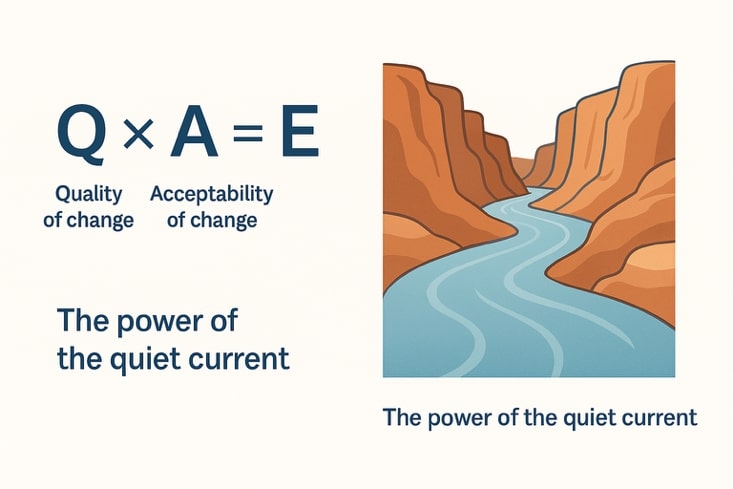
Yes, the big launch matters. The glossy deck has its place. But real change happens in the everyday moments—in the nudges, the prompts, the small wins.
Because transformation isn’t about how brilliantly you design the change.
It’s about how naturally people live the change.
Q × A = E
- Quality matters.
- Acceptability matters just as much.
- Nudges turn resistance into momentum.
When you get the current right, change doesn’t feel like a push.
It feels like flow—quiet, steady, and unstoppable.
About the Author

Simar D Singh is a senior partner at KPMG. He is an influential leader with more than two decades of experience in the financial services sector. His expertise stems from a background in managing substantial segments of international banking operations and delivering transformative change during his tenure at UBS & HSBC. He spent his formative years at GE, where his focus encompassed Six Sigma, change and project management.